Cast Iron Pipe Failure in Fort Lauderdale Ranch Homes: Warning Signs, Diagnosis, and the Sewage Cleanup That Follows
BY RESTORATION DOCTOR OF MIAMI · MIAMI-DADE, BROWARD & PALM BEACH
Cast iron pipe failure Fort Lauderdale homeowners deal with almost always involves the under-slab drain, waste and vent lines in 1950s–1960s ranch houses. Cast iron corrodes from the inside out, and a typical buried service life of roughly 50 to 75 years means most of that original plumbing is now at or past its useful end. Warning signs are recurring backups in the lowest fixtures, gurgling, sewer odor, damp or cracked slab-level tile, and a musty smell that returns after cleaning. Diagnosis is a camera scope plus hydrostatic testing by a licensed plumber. When a line lets go, the resulting loss is Category 3 black water and is handled under IICRC S500 with containment, removal of saturated porous materials, antimicrobial treatment and verified drying — and it is very often a mold job by the time it is found.
Call (786) 213-9489Why is cast iron pipe failure so common in Fort Lauderdale ranch homes?
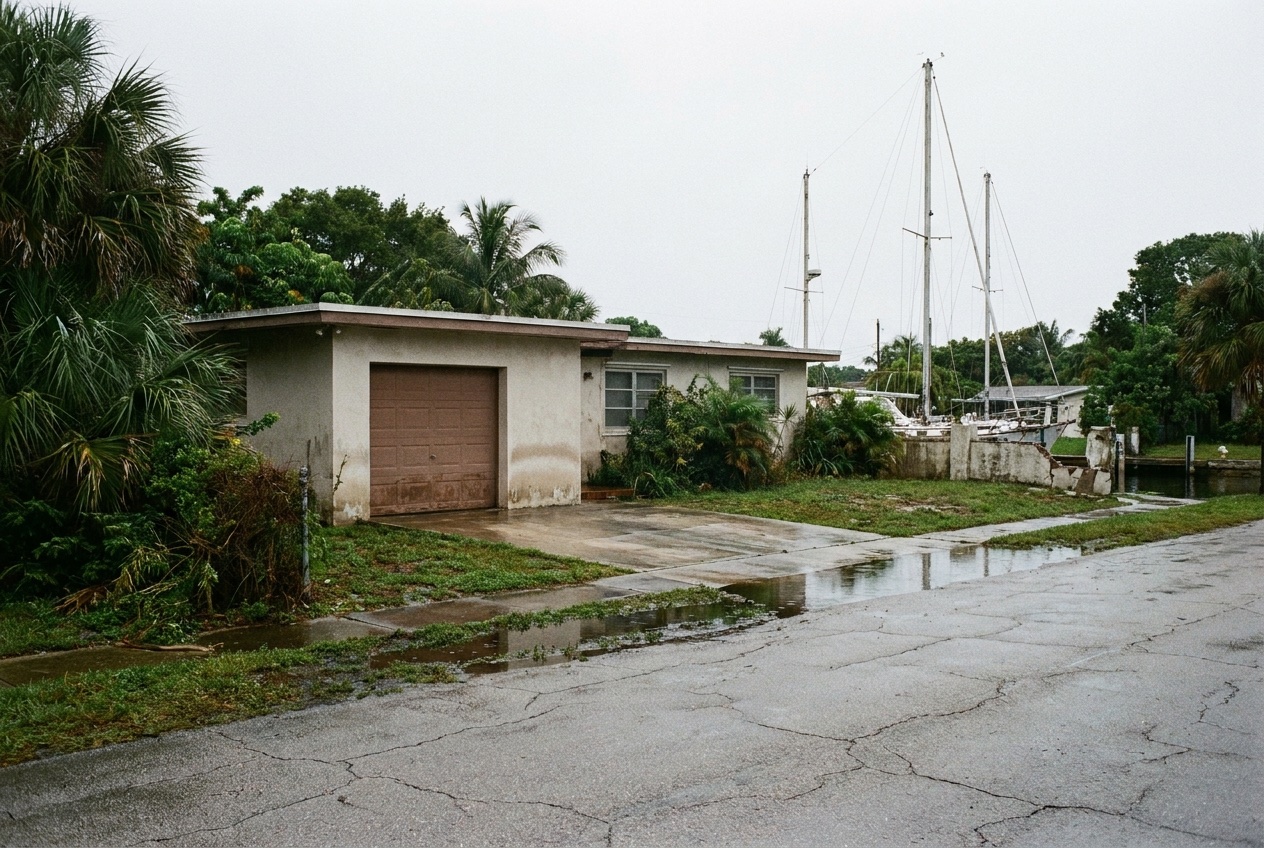
Cast iron pipe failure Fort Lauderdale homeowners run into is not bad luck and it is not a maintenance oversight — it is a material reaching the end of its designed life on schedule. When the ranch neighborhoods east and west of Federal Highway were built out through the 1950s and 1960s, cast iron was simply what drain, waste and vent piping was made of. It was strong, fire-resistant, quiet under load, and it was the code-standard material of the era for anything buried under a slab. PVC drainage did not become the default in residential construction until well into the 1970s, which puts a hard date line through Broward's housing stock: if your house predates that shift and nobody has re-piped it, the drain lines running under your floor are almost certainly the originals.
The homes themselves make the problem harder to see. These are slab-on-grade concrete-block houses — no crawlspace, no under-floor access, nothing below the finished floor but four inches of concrete and then sand. The plumbing that serves the kitchen, the baths and the laundry runs in trenches cut into that grade before the slab was poured. Once the concrete cured, those pipes became effectively invisible. A homeowner can replace every faucet, re-tile every bath and remodel the kitchen twice without ever laying eyes on the pipe that carries the waste away.
Buried cast iron in a residential setting is generally credited with something on the order of a 50 to 75 year service life, and that number assumes reasonable conditions. A house built in 1958 is past the low end of that window and closing on the high end. That is the whole story in one sentence: a very large share of Fort Lauderdale's most desirable mid-century inventory is sitting on drain plumbing that has already spent its budget.
How does cast iron actually fail under a slab?
Cast iron does not usually fail the way people picture a burst pipe. There is rarely a dramatic split. It degrades gradually, from the inside, and the failure that finally announces itself is the last step of a process that has been running for decades.
The dominant mechanism is interior corrosion concentrated at the invert — the bottom of the pipe, where wastewater actually flows and where solids and moisture sit permanently. Sewage is mildly acidic and biologically active; hydrogen sulfide generated in the line converts to sulfuric acid at the pipe wall and eats the iron. Over time this carves a channel along the bottom of the pipe until the invert is thin, then perforated, then simply gone. Plumbers call the result channeling, and a scoped line in this condition often looks like a half-pipe: an intact top arch with an open trough underneath discharging directly into the soil beneath your slab.
- Channeling — the pipe bottom corrodes away, leaving an open trough that leaks waste into the sub-slab soil continuously rather than all at once.
- Tuberculation and scale — corrosion nodules and mineral buildup grow inward and choke the bore, so a four-inch line may pass water like a two-inch line, causing chronic slow drainage long before any leak is visible.
- Graphitization — the iron leaches out of the alloy and leaves behind a soft graphite matrix that still looks like pipe but has little structural strength. It can be scraped away with a tool and collapses under load or during cabling.
- Joint and hub failures — original lead-and-oakum hub joints dry, shift and lose their seal as the pipe corrodes around them, opening a leak path at every connection.
- Bellies — sandy South Florida fill settles unevenly, letting a section sag below grade so waste pools instead of flowing. Standing waste accelerates the interior corrosion in exactly the spot that can least afford it.
- Root intrusion — fine roots find compromised joints and channeled sections, then thicken inside the line, trapping solids and eventually splitting the pipe from within.
Why does South Florida make cast iron fail faster?
The same environment people move to Fort Lauderdale for is unusually hard on buried iron. The water table across much of coastal Broward sits close to the surface — in many neighborhoods only a few feet below the slab, and it rises seasonally with the summer rains and with tide influence near the Intracoastal and the Middle and New River systems. That means these pipes are not sitting in dry sand. They spend much of the year in or just above saturated soil, and iron corrodes from the outside as well as the inside when it is permanently damp.
Add salt. Groundwater in the eastern neighborhoods carries chloride influence from proximity to tidal water, and chlorides are aggressive toward ferrous metal. External pitting on an already thin, internally channeled pipe is what turns a slow decline into a hole.
Then there is the soil itself. Sandy, loosely consolidated fill drains fast and settles unpredictably, which is what produces bellies and shifted joints in the first place. It also means that when a line does start leaking, the waste does not pond politely at the break — it migrates through permeable sand under the slab, spreading contamination and moisture well beyond the pipe run before anything shows up indoors. This is the reason a cast iron loss almost never matches the footprint the homeowner expected.
What are the warning signs a homeowner can actually notice?
Nobody sees the pipe. What people see are symptoms, and the useful skill is recognizing that a cluster of small annoyances is a single story rather than several unrelated ones. The tell is repetition: a drain that clogs once is a clog, a drain that clogs three times in a year is a pipe.
| What you notice | What it usually means | What to do |
|---|---|---|
| Recurring slow drains or backups in the lowest fixtures (tub, shower, floor drain, guest bath) | Scale and tuberculation narrowing the bore, or a belly holding waste; the lowest fixture always shows it first | Stop repeat cabling and have the line camera-scoped before the next clearing |
| Gurgling from a tub or toilet when another fixture drains | Restricted flow or a compromised vent — air is being pulled through the trap seal | Note which fixtures pair up and give that to the plumber; it localizes the run |
| Sewer odor in a bathroom, near a wall, or over the yard | Gas escaping a failed joint or channeled section under the slab or in the lateral | Treat as a leak, not a dry trap, if it persists after running water |
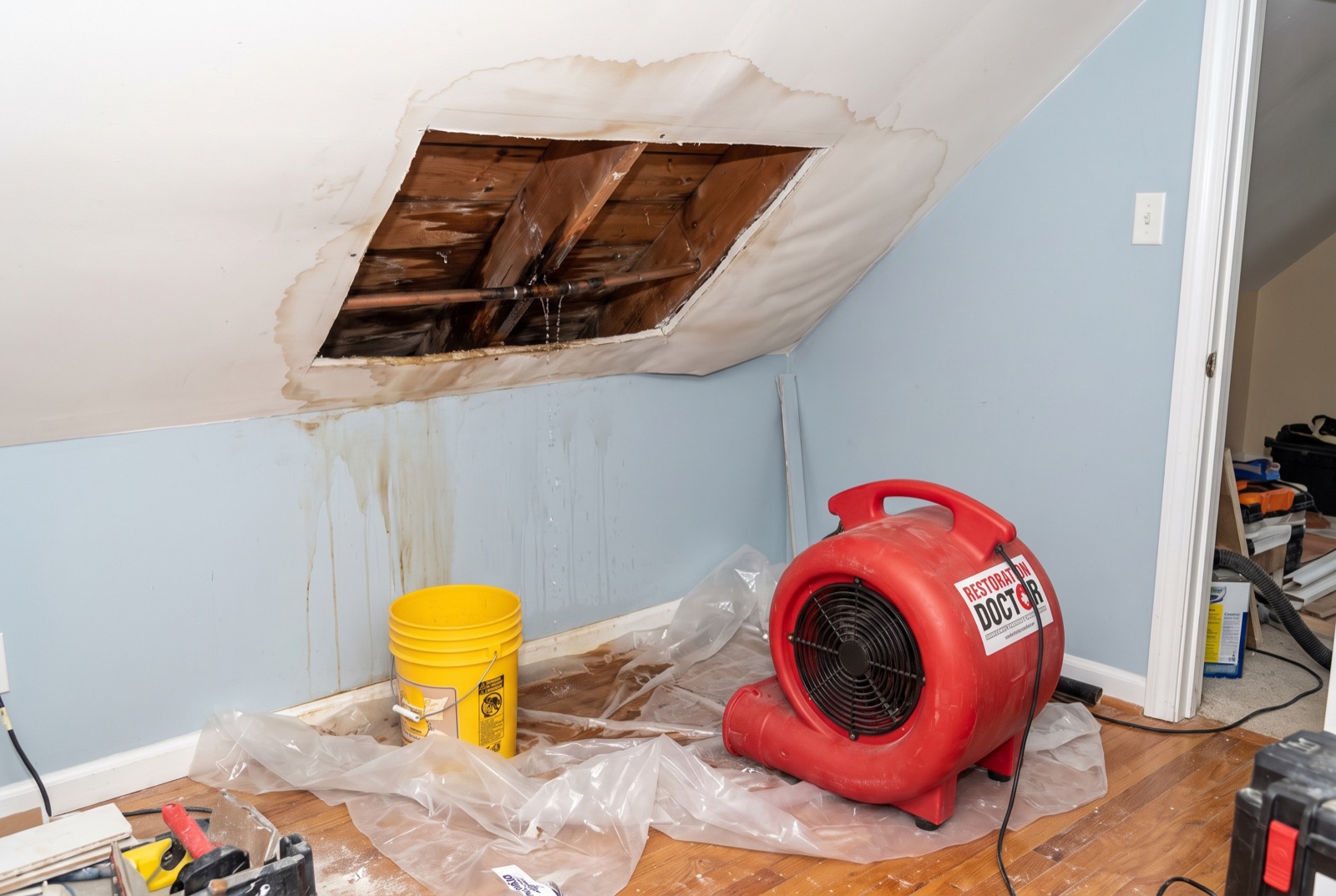
| Damp, discolored, or persistently cool spots on tile at floor level | Water migrating up through the slab from a leaking line below | Have moisture mapped with meters and thermal imaging — do not paint or seal over it |
| Cracked, hollow-sounding, or lifting tile in a line across the floor | Soil washout beneath the slab from a long-running leak, letting the slab flex | Structural and plumbing issue together; scope the line and document the pattern |
| Musty smell that returns days after cleaning | Chronic moisture feeding growth inside wall bases or cabinet toe kicks | Stop deodorizing and get the source found; odor is a symptom, not the problem |
| Damp baseboards or blistering paint on an exterior wall with no fixture nearby | Sub-slab moisture wicking outward along the wall base from a distant leak | Map the moisture; the wet edge is usually far wider than the visible stain |
| Roaches or other pests appearing suddenly and repeatedly indoors | A broken drain line is a direct highway from soil and sewer into the structure | A pest problem that resists treatment is worth a plumbing scope |
| Unexplained rise in the water bill with no visible drip | Often a supply issue rather than drain, but worth ruling out alongside the drain scope | Have supply and drain evaluated together so nothing is assumed |
How is a failing cast iron line diagnosed?
Guessing is expensive here, because the remedy involves opening a concrete floor. The diagnostic work is done by a licensed plumber and it follows a fairly standard path.
A camera scope comes first. A push camera goes down a cleanout and travels the line while recording, and the video shows exactly what a homeowner can never see: the depth of channeling, how much bore is left, where the joints have opened, where roots have entered, and where the pipe sags. Distance is read off the camera reel and correlated with a locator that traces the camera head from above, so problem points can be marked on the floor with a paint dot rather than guessed at.
Hydrostatic testing complements the scope. The system is plugged and filled to a known level, and the level is watched. A camera shows you what a section looks like; a hydrostatic test tells you whether the system as a whole holds water. A line can look survivable on video and still fail a static test, which is the evidence that settles the repair-versus-replace argument.
Insist on getting a copy of the scope video and the still captures. It matters twice. It is the basis for a sane repair decision — you can see whether you are dealing with one failed joint or forty feet of half-gone pipe. And if the failure produced a water or sewage loss inside the home, that footage becomes part of the documentation package alongside our photos, moisture logs and line-item estimate. The stronger and more contemporaneous the record, the less argument there is about what happened and when.
What are the repair options, and what are the honest trade-offs?
We should be clear about where our lane ends. Restoration Doctor is a restoration contractor. We do not repair or replace your drain lines — that is a licensed plumber's scope, and it should be. What we do is everything around it: the emergency response, the containment, the demolition of contaminated finishes, the drying, the decontamination and the rebuild. We work alongside your plumber constantly and we would rather explain the options plainly than pretend we are neutral about a job we do not perform.
Costs on this work vary enormously with the length of the run, the depth of the trench, access, how many fixtures are involved, the finishes being removed, and what the scope turns up once the floor is open. Any figure quoted before a scope is a guess. As a rough orientation only, spot repairs commonly land somewhere in the low four figures, lining and bursting projects frequently run from the mid four figures into the low five figures, and a full under-slab re-pipe of a whole house can range from the high four figures well into the mid five figures or beyond on larger or heavily finished homes. Treat those as wide brackets, not quotes.
- Spot repair — open the slab at one identified failure, cut out the bad section, splice in new. Least disruptive and least expensive, but it only makes sense when the rest of the system scoped and tested well. On a system that is uniformly thin, it buys time and little else.
- Pipe lining (CIPP) — a resin-saturated liner is cured in place inside the existing pipe, forming a new pipe within the old one. No trenching through the floor. Requires enough host pipe left to line against, complicates branch connections and reduces the interior diameter slightly, and quality depends heavily on the installer.
- Pipe bursting — a bursting head is pulled through the old line, fracturing it outward while towing new pipe behind. Trenchless along the run but still needs access pits, and it is better suited to straighter laterals than to a complicated branch layout under a house.
- Full re-pipe, under-slab — trench the slab, remove the cast iron, install new PVC. The most complete answer and the most invasive: concrete cut and removed, dust and noise, then floor, cabinetry and finish restoration afterward.
- Full re-pipe, overhead or rerouted — abandon the under-slab drains and re-route new lines through walls, attic or ceilings where the layout allows. Avoids trenching the floor, but costs ceiling and wall finishes instead and is not workable in every home.
What does the restoration side involve when a line lets go?
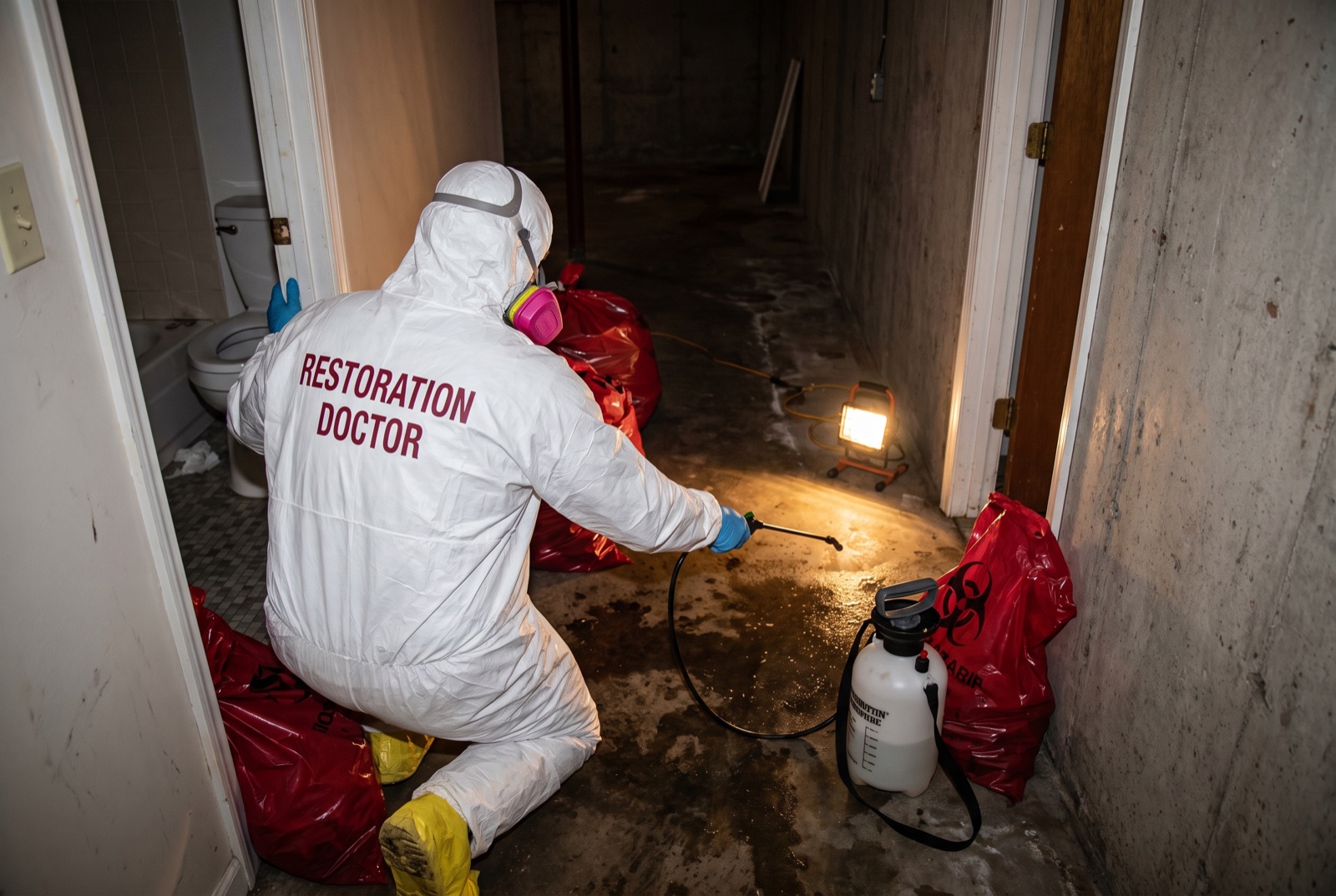
When an under-slab drain line discharges into the home, this is not a clean-water event. Sanitary sewage is Category 3 water under the IICRC S500 standard — grossly contaminated, capable of carrying bacteria, viruses and other pathogens. It is handled with that assumption from the first minute, regardless of how it looks or smells.
The sequence on a live sewage loss in a slab home generally runs like this. We establish containment and set negative pressure with HEPA filtration so contamination is not tracked or blown into unaffected rooms. Crews work in appropriate PPE. Standing waste is extracted, and the affected area is mapped with moisture meters and thermal imaging rather than assumed from the visible edge — under a slab in sandy soil, the wet area is routinely much larger than the stain.
Saturated porous materials in the contaminated zone come out: carpet and pad, affected drywall and its wall base, insulation, particleboard cabinet bases and toe kicks, and any wood flooring over the affected slab. Porous materials that have absorbed Category 3 water are not restored to a safe condition by drying them — the standard is removal. Hard surfaces that stay are cleaned and treated with an EPA-registered antimicrobial.
The plumber's slab break-out happens inside this controlled environment. Concrete is cut and removed over the failed run, the trench is opened, and here is a step people underestimate: the soil under a channeled pipe has been absorbing waste, sometimes for years. That contaminated soil is handled and removed as part of the scope, not backfilled over. Once the plumbing is repaired and inspected, the trench is packed and the slab patched.
Then the drying work proper — directed airflow and dehumidification on the slab, wall cavities and cabinet runs, with readings logged daily until the affected materials hit documented dry standard against unaffected reference areas. Dry is a number we can show you, not a technician's opinion. After verification, reconstruction: tile, wall base, drywall, paint, cabinetry and trim back to pre-loss condition.
Why do so many cast iron jobs turn into mold jobs?
Because of the timeline. A supply line burst floods a house in an afternoon and everyone knows about it immediately. A channeled cast iron drain leaks a little every time somebody flushes, for months or years, into sand under a concrete floor. There is no dramatic moment. The first indoor evidence is often a musty smell, a soft baseboard or a cabinet base that has gone spongy — and by then the moisture has been feeding growth in a dark, undisturbed, warm cavity for a long time.
South Florida conditions do the rest. With indoor humidity high year-round and ambient temperatures in the range mold likes best, a chronically damp wall base or cabinet interior is close to ideal growth conditions. It is entirely normal for us to arrive on what the homeowner described as a plumbing problem and find that the actual scope is remediation of established growth behind the vanity run and along the wall base, with the plumbing repair being only the trigger.
Where we find established growth, the work shifts to remediation under IICRC S520 — containment, negative air with HEPA filtration, controlled removal of affected materials, HEPA vacuuming and detail cleaning of the containment, and post-remediation verification before anything is closed back up. We would rather find it, document it and remove it than paint over a wall that is going to smell again in three weeks.
How does insurance usually treat a cast iron failure?
This is the question every homeowner asks, and it deserves a careful answer rather than a comfortable one. Policies differ, carriers differ, and nobody should promise you an outcome — including us. But there is a general pattern worth understanding before you make decisions.
Most homeowner policies are built to respond to sudden and accidental discharge of water, and to the resulting damage to the structure and contents. What they generally do not cover is the failed pipe itself — the cost of repairing or replacing the plumbing is typically the homeowner's, on the reasoning that a worn-out component is maintenance rather than a covered peril. Many policies do include some form of tear-out and access coverage, meaning the cost of breaking the slab to reach the failed line and putting that concrete and finish back may be treated differently from the pipe repair itself. And nearly every policy contains exclusions for damage from long-term seepage, repeated leakage, or deterioration occurring over a period of time — which is precisely the shape a slow cast iron leak takes.
That combination is why documentation of a sudden discharge matters so much on these losses, and why we photograph and log from the first walkthrough. Date-stamped photos of the condition on arrival, moisture readings from every affected material, daily drying logs, the plumber's scope video, and a line-item estimate written to industry-standard pricing all describe what actually happened in a form a carrier can evaluate. We make no representation about how any particular claim will be decided — but a well-documented file is a far better position than a recollection.
On the billing side, we want to be direct because the industry often is not. You are our customer. We do not bill your insurance company, and we are not a party to your claim. You are responsible for payment for the work we perform. What we provide is a complete, IICRC-grade documentation package — photos, moisture and psychrometric logs, scope narrative, and a detailed line-item estimate — that you submit to your carrier for reimbursement under your policy. That arrangement keeps our obligations to you rather than to an adjuster, and it is why our scope reflects what your home actually needs.
What should you do in the first hour?
If sewage has come up into the home or you have found active leakage, the first hour is about limiting exposure and preserving evidence — in that order.
- Stop putting water into the system. No sinks, showers, dishwasher, laundry or toilets on the affected side of the house. Every gallon you send down a broken line goes under your slab.
- Keep people and pets out of the affected rooms. Category 3 water is a health exposure, not just a mess. Children, elderly household members and anyone immunocompromised should stay well clear.
- Do not run a household fan across contaminated water. Blowing air over sewage aerosolizes it and moves contamination into rooms that were clean.
- Do not start demolition or bag things up yourself. Contaminated material handling is part of a documented scope, and once it is in a dumpster it cannot be photographed in place.
- Photograph everything before anything moves — wide shots of each room, close shots of the water line, the affected flooring, cabinet bases and any visible growth. Time-stamped phone photos are legitimate documentation.
- Shut off power to affected areas at the breaker if water is anywhere near outlets, cords or appliances. If that means working in standing water to reach the panel, do not — wait for help.
- Call a licensed plumber for the line and call our 24/7 dispatch line for the restoration. Those are two different trades and both clocks are running.
- Locate your policy and note the date and time you first observed the discharge. That detail matters later and memories blur fast.
Which Fort Lauderdale neighborhoods see this most?
Broadly, anywhere the housing stock predates the switch to plastic drainage. That covers a lot of the city's most established residential areas — the mid-century ranch blocks of Coral Ridge and Imperial Point, the older sections of Oakland Park and Wilton Manors, and the pre-war and post-war cottages and ranches around Victoria Park, Rio Vista and Tarpon River. What these areas share is not a defect; it is an era. They were built well, in the material of their time, and that material has now aged out.
There is a renovation wrinkle worth naming. Many of these houses have been beautifully updated — new kitchens, new baths, porcelain tile throughout. Those remodels almost never touched the under-slab drains, because doing so would have meant trenching the floor the owner was about to finish. So a home can present as fully modern and still be running 1950s cast iron three inches below that new tile. If you are buying in one of these neighborhoods, a drain line camera scope is one of the highest-value inspections you can add, and it is not part of a standard home inspection unless you ask for it.
If you already own one, the useful posture is neither panic nor denial. Get the line scoped so you know what you have, keep the video, and treat recurring drain trouble as information rather than an inconvenience. A planned re-pipe on your schedule is a fundamentally different event than an emergency sewage loss on a Saturday night.