Commercial Restoration in Fort Lauderdale
Large-loss mitigation and reconstruction for Broward County commercial property — Las Olas storefronts and restaurants, downtown and Cypress Creek office suites, beachfront hotels along A1A, marinas and yacht service facilities, Port Everglades-adjacent warehouses, and the condo and HOA towers a property manager answers for.
What counts as a commercial restoration loss in Fort Lauderdale?
Commercial restoration Fort Lauderdale businesses actually need covers any building that earns revenue or houses tenants — a Las Olas Boulevard storefront or restaurant, an office suite in the downtown corridor or a Cypress Creek business park, a beachfront hotel or resort along A1A, a medical or dental practice, a marina office or yacht service building, a warehouse in the industrial belt near Port Everglades, a house of worship, a school, or the condo and multifamily buildings a Broward property manager or association board oversees. The physics of the damage — water, wind and storm, fire and smoke, mold, sewage — are the same as a residential loss. Everything around the damage is different: the square footage, the number of tenants affected, the revenue clock running while the doors are closed, and the number of parties who need the same defensible record of what happened.
Fort Lauderdale adds failure modes that a generic commercial playbook does not account for. The city is a grid of canals and finger islands, and a large share of its commercial stock sits at low elevation within a few feet of tidal water. Ground-floor retail, garden-level office suites, and below-grade or at-grade parking structures take on water during king tides and heavy seasonal rain even when no pipe has failed and no storm has landed. That water is often brackish or fully saline, which changes how the loss must be handled from the first hour. Layer on year-round humidity that pushes an untreated water loss toward microbial growth in roughly 24 to 48 hours, hurricane season events that damage entire portfolios at once, and mid-century commercial buildings across Fort Lauderdale, Oakland Park, Wilton Manors and Pompano Beach running original cast-iron drain lines under their slabs, and you have a market where commercial losses are frequent, fast-moving, and rarely as simple as they first look.
The scale question matters too. A failed riser or supply line on an upper floor of a Broward tower does not stay on that floor — it runs down through demising walls, elevator shafts, stair cores, and electrical rooms, wetting units and common elements the reporting party never mentioned because nobody had opened those doors yet. That is why we scope a commercial loss with moisture mapping and thermal imaging across the whole affected column of the building rather than only the room where somebody noticed the ceiling stain, and it is why our first conversation with a property manager is about the building, not just the unit.
How fast can you mobilize for a Broward commercial emergency?
Speed is the single biggest lever on the final cost of a commercial loss, so our commercial intake runs 24 hours a day, every day of the year, and it does not sit in the general residential queue. For an operating business the difference between a one-hour and a four-hour response is frequently the difference between drying a corridor in place and demolishing a floor — and in this climate it is also the difference between a water project and a mold project.
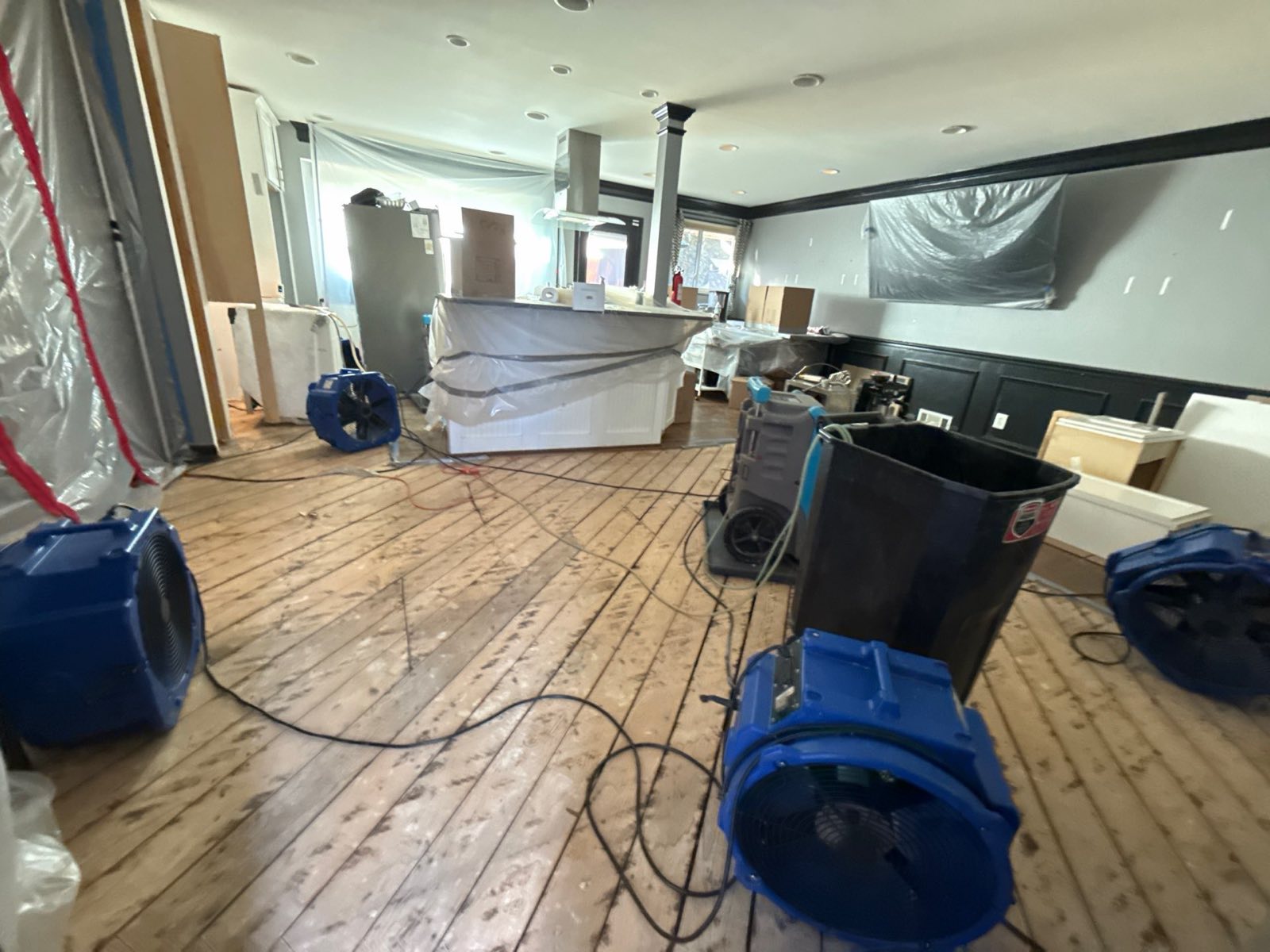
On first mobilization we do three things simultaneously: stop or isolate the source, extract standing water and stabilize the structure so the loss stops growing, and scope with moisture meters and thermal imaging so the drying plan is built on readings rather than assumptions. For a large or multi-floor loss we scale rather than ration — staging additional air movers, high-capacity refrigerant and desiccant dehumidification, negative-air machines, and generator capacity as the moisture map dictates, instead of making a building wait two days for a second truck. Company-wide, our teams have completed more than 26,000 restoration projects, and that portfolio depth is what lets us commit crews to a large commercial loss without pulling the plug on the jobs already running.
Traffic and access are part of response time here, and we plan for them. Getting equipment onto Las Olas during dinner service, into a downtown tower with a single freight elevator and a strict loading-dock window, into a beachfront hotel on A1A during season, or into a secured yard near Port Everglades is a logistics problem as much as a restoration one. We ask the access questions during the intake call so the truck that arrives can actually get to the water.
King tides, tidal flooding, and low-lying commercial property
Tidal flooding is the loss type that most distinguishes Fort Lauderdale commercial work from inland commercial work. During king tide season, elevated water pushes up through the storm drainage network and through porous limestone, and it arrives at ground-floor commercial space from below and behind rather than from a roof or a pipe. Canal-front restaurants and retail, waterfront office suites, marine service buildings, and at-grade or partially recessed parking structures see recurring intrusion that a landlord may have learned to mop up and ignore. That is an expensive habit: repeated wetting of bottom plates, base cabinetry, and slab-adjacent framing produces cumulative deterioration and hidden growth long before anyone files a claim.
Tidal and canal water is not clean water. Under IICRC S500 categorization it is handled as contaminated, which means the response is not simply drying — it is removal of unsalvageable porous materials, controlled demolition to a defined line, antimicrobial application, and verified drying with documentation of the contamination decision. Treating a saltwater intrusion event as a clean-water dry-in-place is one of the most common and most costly mistakes we are called in to correct after another vendor has already left.
For parking structures and ground-floor spaces with a repeat history, the more valuable conversation is the one that happens between events. We can document existing conditions, identify the entry paths, and coordinate with the owner's engineer or plumbing contractor on backflow prevention, drain modification, threshold and door-seal work, and equipment elevation. Restoration is the emergency service; reducing how often you need it is the part that saves a commercial operator real money over a five-year hold.
Saltwater intrusion versus freshwater loss: why the handling differs
A supply-line break delivers clean potable water. A tidal event, a storm surge, or an intrusion through a seawall or dock structure delivers saline water carrying silt, organics, and whatever the canal system is holding that week. Those two losses look identical on arrival and diverge completely in how they must be handled, and the distinction is worth understanding before you approve anyone's scope.
Salt is hygroscopic. Once saline water has wicked into drywall, insulation, or wood framing, the residual chloride keeps pulling moisture out of humid Broward air even after the initial water is gone — so a wall that meters dry in week one can re-wet on its own in week four. That is why salt-affected porous materials generally come out rather than staying in place to dry, and why we set the demolition line based on documented salinity and moisture migration rather than a default two-foot flood cut. Salt is also aggressive on metal: fasteners, track, electrical boxes, panel interiors, conduit, HVAC coils, and elevator pit hardware all corrode faster after saline exposure, so those components get inspected and called out in the scope instead of being left for the tenant to discover.
Marine and waterfront properties get a further layer of attention. Boatyards, yacht service facilities, marina offices, and dock-adjacent commercial buildings live with salt air continuously, which means the baseline corrosion and moisture picture is different from a building three miles inland — and it means the documentation has to distinguish new loss-related damage from long-standing environmental wear. Getting that separation right in the file is often what determines whether a claim is paid cleanly or argued for months.
How do you keep my business running during restoration?
For an operating business or an occupied building, closing entirely is frequently the most expensive outcome of a loss — often costing more than the physical damage. Our commercial approach is built around continuity: rigid and poly containment barriers with negative air isolate the affected zone so the rest of the building keeps operating, and phased overnight and weekend work moves drying and reconstruction forward without shutting you down during revenue hours.
That plays out differently by property type, so we plan it by property type. A Las Olas restaurant needs the dining room and the kitchen line protected and the work compressed into the hours between close and prep, with health-department-conscious handling of any affected food-contact area. A downtown or Cypress Creek office tenant needs quiet hours protected, server rooms and IT closets isolated first, and cabling and equipment tented before demolition dust exists. A beachfront hotel needs guest-facing corridors kept presentable, room blocks staged so the property can keep selling inventory, and equipment routed through service elevators outside guest-traffic peaks. A warehouse or distribution space near Port Everglades needs racking and inventory relocated or elevated and a dock schedule that still works.
In every case the goal is identical: dry and rebuild the damaged envelope to standard while the parts of the building that can keep earning, keep earning. We would rather run a longer, staged schedule that protects your revenue than a shorter one that closes your doors — and we will tell you honestly when a full closure genuinely is the faster and cheaper path.
Cast-iron drain failures under mid-century commercial slabs
A large share of Fort Lauderdale's commercial building stock — much of the older Las Olas and downtown inventory, the Oakland Park, Wilton Manors and Pompano Beach mixed-use strip, and mid-century office and retail across Plantation — was built with cast-iron drain, waste and vent piping. Cast iron installed decades ago in a hot, humid, saline coastal environment does not fail politely. It corrodes from the inside, channels along the bottom of the pipe, and eventually breaches below the slab, where the leak goes unseen until you get sewer odor with no visible source, unexplained damp slab edges, cracking or lifting flooring, recurring drain backups in the same fixture group, or interior mold in a building with no roof or plumbing history above.
This matters commercially because it is a Category 3 loss under the slab of an occupied business, and it is almost never a one-room event. Our approach is to locate the failure precisely before anyone breaks concrete — camera inspection of the line, moisture mapping across the slab, and thermal review to define the wetted footprint — then scope the concrete cut, the sanitization, the structural drying, and the flooring replacement as one coordinated sequence rather than three separate surprises. On a phased scope we work with the owner and their plumber to sequence pipe replacement so the business closes once, not repeatedly.
If your building predates the 1980s and you are seeing repeat drain issues in the same area, treat it as a building-systems problem rather than a series of unrelated clogs. Documenting the pattern early gives you a far stronger position with both your carrier and any future buyer than reacting to the eventual under-slab rupture.
Hurricane season and business-continuity planning
Broward's exposure is not theoretical, and the practical problem with a named storm is not just wind — it is that the entire county needs restoration contractors during the same 72 hours. Crews, dehumidifiers, generators, and roofing tarps are finite, and the buildings that get stabilized first are almost always the ones whose owners had a relationship in place before the cone appeared on the map.
Pre-season, we walk the properties we cover and build a per-building plan: where the water historically enters, where the shutoffs and panels are, which elevator serves which stack, who has keys and after-hours access authority, what the loading-dock constraints are, which tenants are mission-critical, and where equipment can stage. We flag the vulnerabilities worth fixing while the sky is clear — roof drain and scupper clearing, failing sealant at window and curtain-wall joints, door sweeps and thresholds at ground-floor commercial, sump and pump testing in parking structures, elevating anything valuable off the lowest floor.
Post-storm, the sequence is stabilize, document, then rebuild: tarping and board-up to stop ongoing intrusion, power and dehumidification staged so the building is not sitting wet in August heat, and a photographic and moisture record captured before any cleanup alters the evidence. That last point is where owners lose the most money. Cleaning up before documenting is understandable and it is the most expensive instinct in this business — the loss you cannot prove is the loss you fund yourself.
Broward condos, HOAs, and property-manager coordination
In a Broward condo or multifamily building, a single loss routinely touches several units and the common elements at once, and the parties involved — unit owners, tenants, the association, the management company, and multiple carriers — need documentation that clearly separates what happened where and which party owns which portion of the repair. We provide a single point of contact, per-unit and common-element scope breakdowns, and a documentation package a manager or board can forward to residents, owners, and insurers without rewriting it into three different versions.
Association work has its own procedural reality and we plan around it rather than fighting it. Access to occupied units in a coastal tower requires notice and escort coordination. Many buildings restrict work hours, freight elevator windows, and hallway staging. Boards have approval thresholds that turn a scope over a certain dollar amount into a meeting agenda item rather than a same-day decision. Seasonal residency means a unit may be unoccupied for months, which is exactly how a small leak becomes a six-unit vertical loss. We build these constraints into the schedule up front and put the request in writing so a manager can act on it without chasing us for details.
Because water in a tower travels through shared assemblies, we dry and document across every affected unit rather than treating each as an isolated job. That is how hidden moisture in a shared demising wall or at a slab edge gets found in week one instead of surfacing as a mold discovery — and a far larger claim — two months later. Clean records of source, timeline, and scope protect the board, the manager, and the individual owners simultaneously, and they keep a multi-stakeholder claim from stalling on the question of who caused what.
What does commercial restoration cost in Fort Lauderdale?
Honest answer: it varies enormously with scope, and anyone quoting a firm number before scoping the building is guessing. What actually drives the figure is the affected square footage, the water category, how many days of equipment the structure needs to reach dry standard, how much porous material has to be removed and rebuilt, and whether the work has to be phased around an operating business or done in an empty space.
As rough planning ranges only, and subject to change once the loss is scoped: a contained single-suite water loss in a Broward office or retail space typically lands in the low four figures to the mid five figures. A multi-unit or multi-floor loss in a condo tower, a hotel, or a larger commercial building commonly runs from the mid five figures into six figures once reconstruction is included. Category 3 losses — sewage backups, under-slab cast-iron failures, tidal and saline intrusion — carry meaningfully higher costs than clean-water losses of the same square footage because of contaminated-material removal, disposal, and sanitization requirements. Reconstruction is quoted separately from mitigation, and specialty finishes, custom millwork, commercial kitchen equipment, and marine-grade materials move the number.
You will get a written line-item scope before reconstruction begins, priced on industry-standard estimating so the numbers reconcile against what a carrier's estimator will produce. If a decision changes the price mid-project, you hear it from us before the work happens, not on the final invoice.
Documentation and insurance for commercial claims
Commercial claims are documentation-intensive, and the quality of the file is usually what determines how fully and how quickly the claim settles. Every project is documented in CompanyCam with time-stamped, geotagged photos from arrival through verified dry standard, alongside daily moisture and psychrometric readings, thermal images, equipment logs, and a line-item scope — the IICRC S500 and S520-aligned record a property carrier, a tenant's policy, and a business-interruption adjuster all need to see.
Our billing model protects the property owner, and we are direct about it: we bill you — the owner, the association, or the management company that hires us — and we hand you a complete carrier-ready claim file that you submit to your insurer. We do not bill your insurance company directly, and we would encourage caution with any contractor who tells you the carrier is their customer, because whoever pays the contractor is who the contractor answers to. That structure keeps us working for you, which matters most on exactly the large or contested commercial claims where the pressure to trim a scope is highest.
Practically, that means the file we hand over is built to survive scrutiny: source and cause documented, category and class justified, drying decisions supported by readings rather than opinion, and every removal and rebuild line tied to a photograph. If your adjuster or their consultant wants to walk the site, we will meet them there and explain the readings. What we will not do is soften documentation to make a claim easier to close at your expense.
Built for commercial scale
What a property manager or facility director is actually buying when they call a company built for commercial and high-rise losses.
A 24/7 commercial intake that skips the general queue and asks the access questions up front — freight elevator windows, loading docks, after-hours authority — so the first truck can actually reach the water.
King-tide and canal-front losses treated as contaminated saline events, not clean-water dry-ins: documented salinity and migration, correct demolition lines, and corrosion inspection on metal, electrical, and HVAC components.
Truck-mounted extraction, refrigerant and desiccant dehumidification, generators, and the crew count to dry a full vertical column of a Broward tower instead of one unit at a time.
Containment, negative air, and phased overnight and weekend work sequenced by property type — restaurant close-to-prep windows, protected office quiet hours, hotel room-block staging, warehouse dock schedules.
Pre-season building walks and a per-property emergency plan on file — shutoffs, panels, access authority, staging areas, and the vulnerabilities worth fixing before the cone appears on the map.
Camera inspection, slab moisture mapping, and thermal review to find a failed mid-century drain line precisely before any concrete is cut — then one coordinated closure instead of three separate ones.
A single point of contact, per-unit and common-element scope breakdowns, and documentation a Broward manager or board can forward to residents, owners, and insurers without rewriting it.
CompanyCam photo logs, daily moisture and psychrometric readings, equipment logs, and a line-item scope handed to you as a claim file you submit — we bill you, never the insurance company.
Frequently asked
Active water, mold, fire, or sewage event?
Connect directly with the Restoration Doctor team for your region. Crews are on standby 24/7 with documented response protocols.