
Water Damage Restoration in Victoria Park, Fort Lauderdale
Water damage restoration Victoria Park Fort Lauderdale homeowners call for usually has less to do with the ocean than with age. This is one of the city's oldest platted neighborhoods, laid out in the 1920s and filled in through the 1950s, and its charm — Mediterranean Revival cottages, Craftsman bungalows, Art Deco corners, and mid-century ranches — sits on top of building systems that are, in many houses, several decades past their design life. When a supply line lets go behind a plaster wall or a cast-iron drain finally corrodes through under a slab, the water finds materials that do not shrug it off. Restoration Doctor of Miami answers Victoria Park losses around the clock at (786) 213-9489.
The neighborhood is not on the finger isles, so it does not take brackish water over a seawall the way the canal streets do. Its exposure is inland and vertical: rain that outruns the drainage and enters at grade, and interior failures inside houses whose plumbing predates the current codebook. That distinction changes the whole approach. Here we spend more time chasing hidden moisture through original wall assemblies and old flooring build-ups than pumping standing tide water off a garage slab.
We run South Florida operations for the multi-state Restoration Doctor organization from 1200 Brickell Ave, Suite 1950 #1007, Miami, FL 33131 — we do not keep a Victoria Park street office, we come to you. What follows is how the neighborhood's age shapes both the failures we see and the way we dry them.
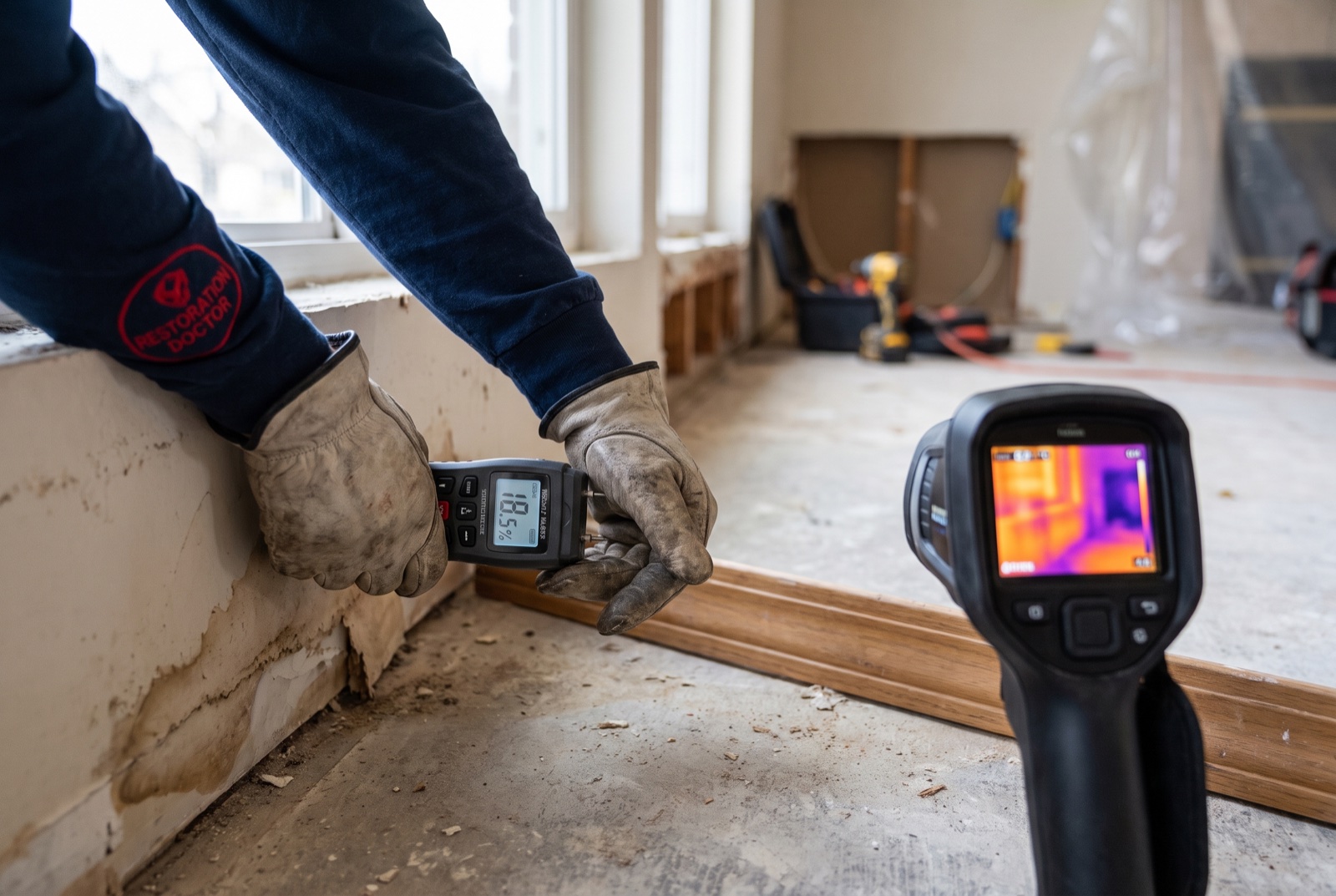
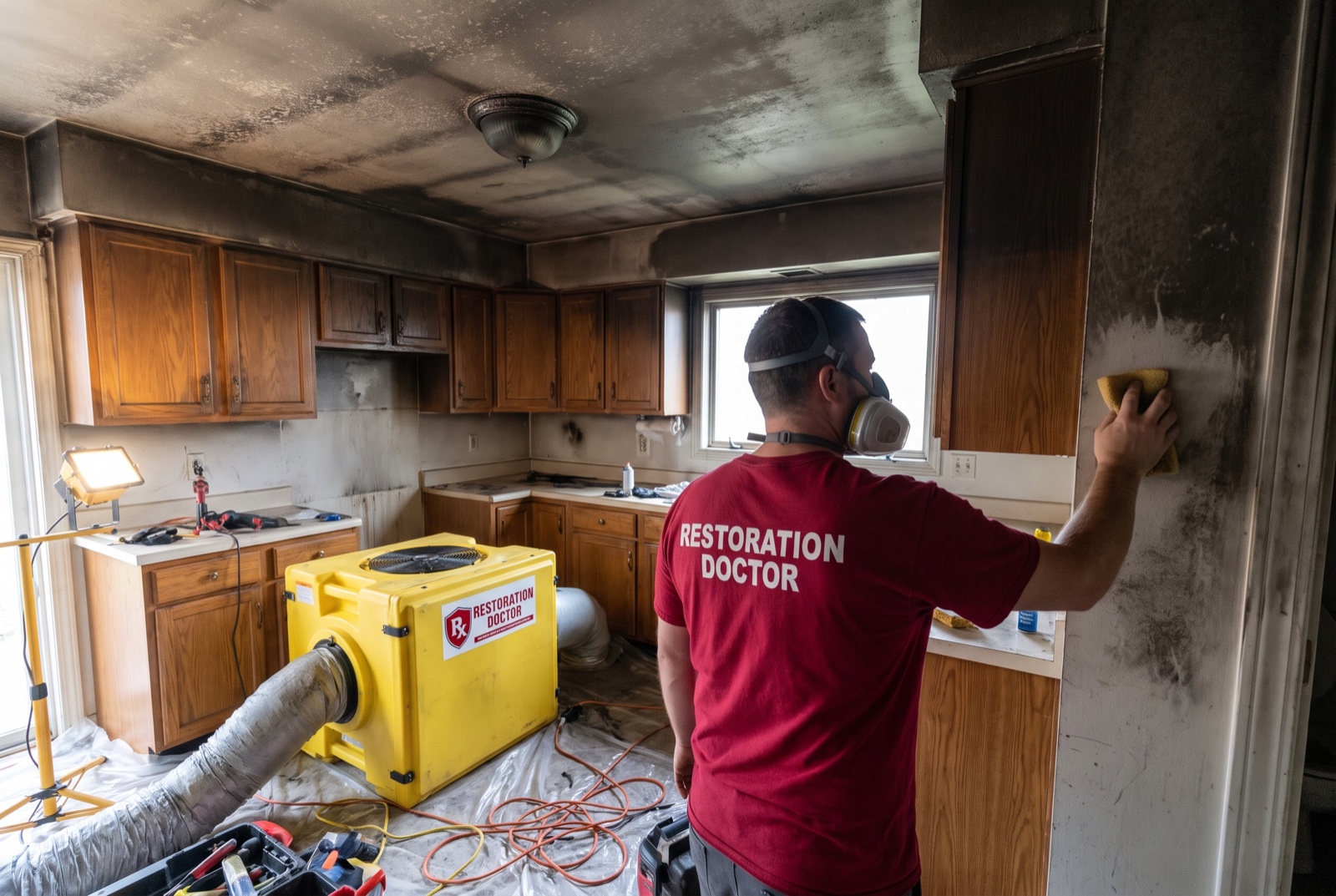
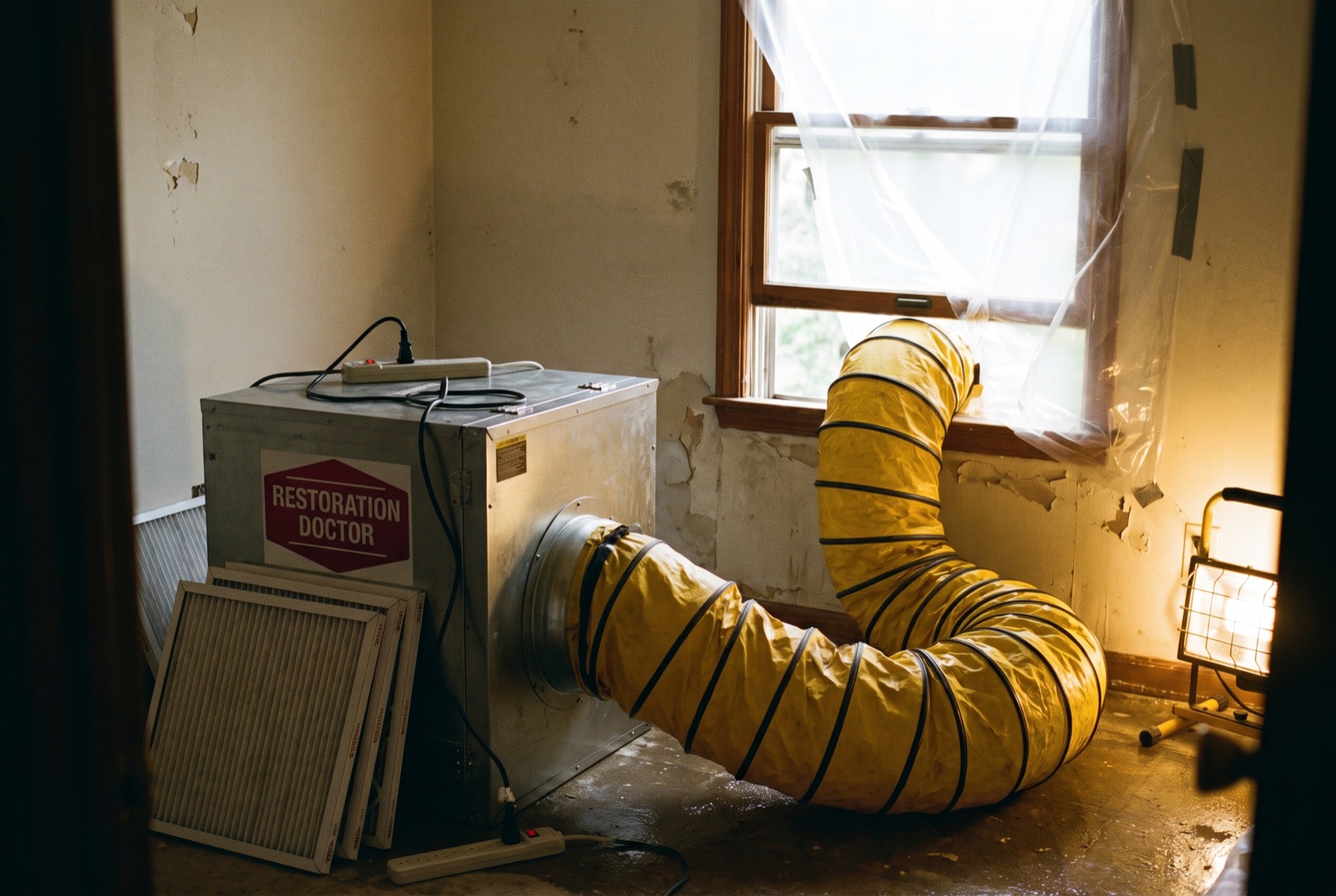
How we dry Victoria Park properties
Illustrative views of the equipment and process our crews deploy — extraction, air movers, LGR dehumidification, moisture mapping, and containment.
How water damage behaves in Victoria Park
When the failure comes from inside the walls
The most common Victoria Park call is not a storm — it is a plumbing failure inside an aging house. A pinhole in a galvanized line, a slab leak under original waste pipe, a failed angle stop under a vanity: clean-water losses at the start, but ones that soak into plaster, wood subfloor, and the paper facing of any drywall added in a later remodel. Under the IICRC S500 standard, category and drying targets drive the work, so we document moisture content in each affected material and dry to a defined goal rather than to a guess.
Age complicates salvage decisions. Plaster and original wood can often be dried in place with the right airflow and dehumidification if we reach it quickly, which preserves the character owners bought the house for. But hidden cavities in old construction also hold moisture longer, so we verify with meters before we call anything dry, and we flag the wall assemblies — behind cabinet runs, under stair stringers, inside chases — where trapped water likes to hide in these homes.
Rain that the older drainage cannot swallow
Because much of Victoria Park sits on lower-lying inland ground rather than a raised canal lot, its outdoor water risk is heavy rain that overwhelms the surrounding drainage and rises into homes at grade — through thresholds, garage slabs, and low door openings. Fort Lauderdale has already shown how extreme that can get in a stalled storm, and neighborhoods away from the canals were not spared. Street-origin water that enters a home is treated as contaminated, and in South Florida heat the drying clock starts at once.
That grade-level exposure is also why flood coverage comes up in nearly every rain-intrusion conversation here. Rising water from overwhelmed drainage is generally excluded from standard homeowner policies and addressed separately, commonly through the NFIP. Policies vary and we make no coverage promises — but we photograph and log exactly where and how water entered, because that classification is decided from evidence, not assumption.
Humidity, historic materials, and mold
A house from the 1930s or 1950s holds moisture differently than a new build, and Victoria Park's mature tree canopy and older ventilation can keep humidity high in the spaces that matter — closets, interior walls, and the backs of built-ins. Left alone after a leak, saturated plaster and wood in this climate can begin supporting microbial growth within days, and older materials give it more to feed on.
Our answer is speed and verification rather than blanket demolition. We dry aggressively, monitor daily, and only where growth is already established do we remediate under the IICRC S520 standard with proper containment and controlled removal. On a home valued in part for original material, the goal is always to save what can safely be saved and remove only what has genuinely failed.
Victoria Park homes and how they fail
Victoria Park's housing is a genuine patchwork rather than a single builder tract. On one block you find a 1920s bungalow with lath-and-plaster walls and heart-pine floors; a few doors down, a 1950s concrete-block ranch on a slab; on the corner, a contemporary infill build that replaced a teardown. That variety matters after a loss, because the drying strategy for plaster over wood lath is nothing like the strategy for painted CBS wall with a slab underneath, and getting it wrong either leaves moisture trapped or tears out material that could have been saved.
The older stock carries the failure points you would expect from its era: original or first-generation galvanized supply lines that corrode and weep, cast-iron waste stacks that crack, and undersized shut-offs that seize when you finally need them. Many homes have been renovated in layers, so a modern kitchen can sit above 70-year-old drain plumbing, and a leak upstairs can travel along framing for a surprising distance before it shows on a ceiling. We map that travel with moisture meters and thermal imaging instead of guessing from the visible stain, because in a house this age the wet area is almost always larger than the spot you can see.
Victoria Park neighborhoods we serve
Real Broward County communities — and the water losses we most often see in each.
Older single-family blocks north of Sunrise where 1950s ranches on slab take interior plumbing failures.
Historic bungalow streets with lath-and-plaster walls that need dry-in-place methods, not demolition.
Spine street of larger renovated homes where modern kitchens sit above decades-old drain plumbing.
Lower-lying inland blocks prone to grade-level rain intrusion when drainage backs up.
Mature-canopy historic streets between Victoria Park and Las Olas with similar aging-home moisture concerns.
Full restoration services in Victoria Park
One operation covers every category — from emergency mitigation to full reconstruction.
Water Damage Restoration
Extraction, structural drying, and moisture verification for pipe failures, king-tide intrusion, and unit-to-unit leaks in Fort Lauderdale homes, condos, and canal-front properties.
Storm & Hurricane Damage Restoration
Emergency board-up, tarping, storm-surge and flood extraction, and post-hurricane structural drying for homes, canal properties, and condo towers across Fort Lauderdale and Broward County.
Mold Remediation
S520-based mold remediation: containment, HEPA-filtered removal, moisture-source correction, and post-remediation verification for Fort Lauderdale homes, condos, and waterfront properties.
Sewage Cleanup
Category 3 water mitigation: sewage extraction, contaminated material removal, disinfection, and structural drying for backups, drain failures, and tidal surcharge in Broward County.
Fire & Smoke Damage Restoration
Structure securing, soot and smoke residue removal, odor treatment, and combined fire-and-water mitigation for Fort Lauderdale and Broward County properties.
Contents Restoration & Pack-Out
Full-chain contents handling for Broward County: barcode-tracked inventory, pack-out, restoration cleaning, climate-controlled storage, and organized pack-back.
What Victoria Park homeowners look for
Victoria Park owners tend to be house-proud stewards of older homes, and they are wary of contractors who treat a historic bungalow like a gut job. We would rather you check our record than take a rating typed onto this page: verified reviews for the Restoration Doctor operation live at RestorationDoctorsReviews.com, linked to the real Google source.
Read them, weigh them against anyone else you are considering, and call (786) 213-9489 when your older home takes on water.
Frequently asked
Active water, mold, fire, or sewage event?
Connect directly with the Restoration Doctor team for your region. Crews are on standby 24/7 with documented response protocols.